

The Underestimated "Last Mile"
In the glass industry, a widely held maxim states that a furnace‘s operational life is thirty percent determined by the quality of its materials and seventy percent by the quality of its construction. When significant capital is invested in a glass melting furnace and top-grade fused-cast Alumina-Zirconia-Silica (AZS) refractory blocks are meticulously selected, the expectation is a decade or more of safe, efficient operation to maximize the return on investment. However, a paradoxical reality frequently emerges: two furnaces utilizing blocks of the same grade and production batch can exhibit drastically different service lives. One may operate flawlessly for over ten years, while the other suffers from severe premature erosion, glass leakage, or even perforation at critical zones like the throat or doghouse within just five or six years, ultimately forcing an unscheduled and costly cold repair.
A thorough analysis of such premature failures consistently reveals that the root cause is seldom the intrinsic quality of the blocks themselves. Instead, it is often hidden within the barely perceptible gaps, minor misalignments, and overlooked details between them—the quality of the masonry work. This decisive "last mile" of construction is what ultimately translates the theoretical potential of premium materials into the actual longevity and economic performance of the furnace. If Fused Cast AZS Blocks are the high-quality "bones" that form the furnace‘s structure, then exquisite masonry craftsmanship and rigorous process control are the "tendons" and "ligaments" that bind them into a cohesive, load-bearing monolith. This article will systematically explore the profound impact of masonry quality on a furnace‘s overall campaign life, elucidate the underlying failure mechanisms, and present a comprehensive engineering framework for achieving superior masonry execution.
1. The Destructive Mechanisms of Masonry Defects
Fused Cast AZS Blocks are engineered synthetic refractory materials whose exceptional resistance to glass corrosion, high-temperature structural strength, and thermal stability are predicated on maintaining material integrity. Any defect introduced during masonry becomes a critical weak link under the furnace‘s severe operating conditions. These flaws are not merely static imperfections; they are dynamically amplified by heat, chemistry, and mechanical forces, triggering a cascading chain of deterioration.
1.1 Joints: The Accelerated Pathway for Corrosion
In an ideal assembly, joints are completely filled with specialized high-temperature mortar, creating a dense, continuous barrier. In practice, construction shortcomings—such as excessively wide joints, incomplete mortar filling, or poor adhesion—create critical flaws.
Preferential Chemical Attack: Molten glass and alkali vapors are highly penetrative and reactive. They preferentially infiltrate these capillary-like gaps. Since the corrosion resistance of the mortar is typically inferior to the dense AZS block body, the penetrating agents dissolve the mortar first. This rapidly widens and deepens the joint, forming a distinct erosion groove. This process effectively creates a direct conduit for attack into the heart of the refractory structure.
Intensified Mechanical Erosion: The furnace environment involves complex glass convection and rising bubbles, which generate continuous fluid scouring forces. Irregular joints act as "turbulence generators," increasing local flow velocity and turbulence. This dramatically accelerates the wear rate at these specific points. Furthermore, these gaps become collection sites for exuded glassy phases and batch carryover impurities, which can crystallize and further disrupt the local chemical equilibrium.
Thermal Shock Vulnerability: Inadequately filled joints possess different thermal properties (heat capacity, conductivity, expansion) than the surrounding blocks. During furnace temperature cycles—start-up, shut-down, or production changes—this mismatch causes uneven thermal stress. This stress easily induces micro-cracks at the block edges adjacent to the joint, creating new initiation points for deep, penetrating corrosion.
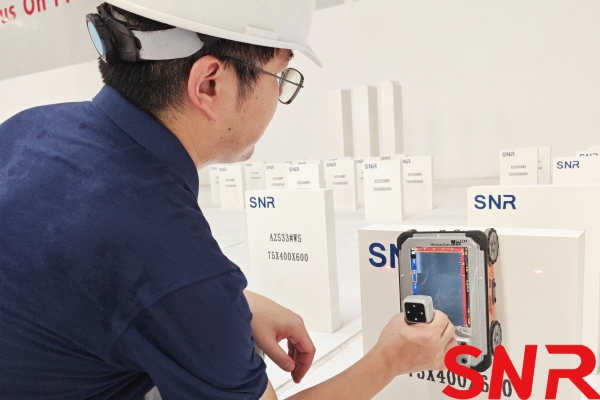

1.2 Dimensional Accuracy: The Source of Structural Stress
The masonry of a large glass melter is a precision three-dimensional structure. The vertical alignment of block rows and the perfect levelness of block courses are geometric prerequisites for long-term structural stability.
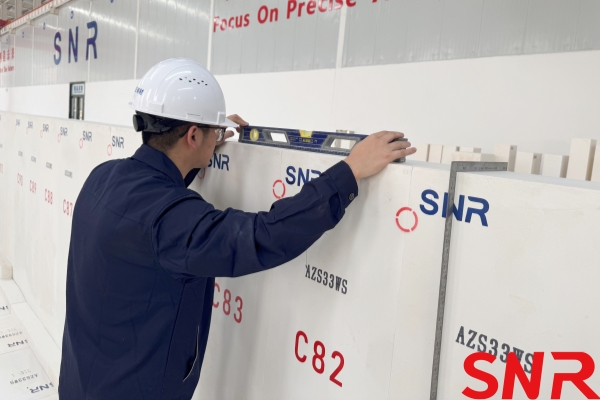
Sidewall Verticality Deviation: Misalignment causing "steps" or leaning between blocks is highly detrimental. It disrupts the designed flow dynamics of the glass bath and, more critically, prevents uniform load distribution. Stress concentrates on small, high-pressure contact points. At operating temperatures above 1500°C, AZS materials undergo creep deformation. These concentrated stress points accelerate local deformation, leading to corner spalling, block displacement, and a eventual loss of the wall‘s structural integrity.
Furnace Bottom Flatness: Imperfections in the paving layer result in uneven support for the blocks above. Under the combined long-term load of the static glass head and thermal expansion, unsupported areas can develop tensile stress, leading to bottom cracking. An uneven bottom also promotes non-uniform glass flow patterns, which can exacerbate localized scouring on specific areas of the sidewalls.
1.3 Expansion Joints: The Delicate Balance
Expansion joints are essential "safety valves," providing designated space for the thermal expansion of the refractory lining. Their design and execution require precision engineering.
Insufficient Allowance: This is a critical error. If expansion space is too small or omitted, the blocks have nowhere to expand. The resulting immense compressive stress can crush AZS blocks, lift entire wall sections, or cause catastrophic damage to the upper superstructure and supporting steelwork.
Excessive Allowance or Failed Filler: Overly large gaps become direct channels for flame impingement and hot gas flow, destroying backup insulation and overheating the steel shell. If the ceramic fiber fillers are sub-specification or poorly installed, they can burn away or dislodge, leading to the same problems of heat loss and structural damage.
1.4 Critical Zones: Where Precision is Paramount
Areas like the throat, doghouse corners, weirs, and electrode openings feature complex block shapes and operate under the most extreme erosive conditions. Masonry precision here must be exceptional.
The Throat: Often constructed with interlocking tongue-and-groove or stepped designs, the throat‘s blocks must fit with near-perfect alignment. Any significant gap at the mating surfaces allows high-velocity glass flow (several meters per second) to act like a cutting jet, eroding the material at a rate orders of magnitude faster than on flat surfaces, leading to rapid thinning and failure.
Electrode Blocks: The annular space around the metal electrode must be perfectly sealed with a compatible, carefully compacted ramming mix. Inadequate sealing allows glass infiltration, which can solidify and, upon thermal cycling, generate sufficient stress to crack the block.
2. A Systems-Based Approach to Superior Masonry
Achieving superior masonry quality is not a matter of chance; it is the result of a deliberate, system-wide engineering philosophy applied from design through execution.
2.1 Foundational Design: Precision from the Start
Calculated Thermal Management: Design must be based on the precise, measured thermal expansion coefficients of the specific AZS grades used in each furnace zone. This data dictates the exact location and width of every expansion joint, planned down to the individual block level.
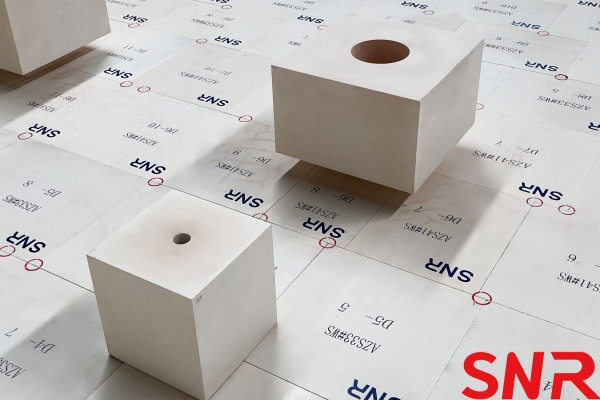
Digital Pre-Construction: Utilizing 3D Building Information Modeling (BIM) for virtual furnace assembly is now standard best practice. This process optimizes block selection, minimizes special shapes, identifies spatial conflicts beforehand, and generates detailed installation maps and block numbering sequences. It is the digital blueprint for physical precision.
2.2 Material Synergy: The Critical Role of Mortars
The notion of a universal furnace mortar is obsolete. Specialized, compatible mortars are non-negotiable. For use with fused cast AZS blocks, mortars must meet stringent criteria:
Chemical & Thermal Compatibility: The mortar matrix must be designed to sinter and form a strong ceramic bond with the AZS block‘s glassy phase at high temperature, with a closely matched thermal expansion profile to prevent interfacial cracking.
Engineered Application Properties: Rheology must be tailored for easy, uniform application, good adhesion, and the ability to fully fill joints without shrinking or cracking during dry-out.
2.3 Execution Control: The Discipline of Process
Joint Integrity: In critical areas, joints must be consistently maintained at ≤1mm. This is verified with feeler gauges. The "double-buttering" technique—applying a full, even mortar coat to all mating surfaces before placement—is mandatory to eliminate voids.
Geometric Control: Real-time verification using laser levels, theodolites, and precision straightedges is essential. For sidewalls, adjustable metal bracing systems are indispensable. These fixtures hold entire rows of blocks in perfect alignment during construction and the initial heat-up phase, counteracting movement before the mortar cures and the structure stabilizes.
Management of Expansion Systems: Joints must be installed exactly per design using specified materials, securely fixed to prevent movement during subsequent work.
Critical Area Protocols: Zones like the throat may require "dry-fit" pre-assembly and the use of internal bracing or tie-rod systems to ensure the complex geometry remains locked under operating conditions.
2.4 The Human and Cultural Factor
Skilled Craftsmanship: Masons must be trained as technicians, understanding material behavior and the "why" behind each procedure. Certification programs elevate standards.
Controlled Environment: A clean, organized, and disciplined worksite is vital. Block handling, cutting (with water-cooled diamond tools), and storage must prevent damage and mix-ups.
Quality Culture: A robust Quality Assurance/Quality Control (QA/QC) plan with defined hold points, inspections, and traceability ensures accountability and consistent execution.
3. The Compelling Economics of Quality
Viewing masonry as a mere construction cost is a profound strategic error. It is, in fact, one of the highest-return investments in a furnace project, analyzed through Total Cost of Ownership (TCO).
3.1 Direct Financial Returns
Extended Campaign Life: The primary benefit. High-quality masonry is the key to achieving—or exceeding—the furnace‘s design life (e.g., moving from 8 to 10+ years). This dramatically reduces the annual capital cost allocated to the refractory lining.
Elimination of Catastrophic Failure: It virtually eliminates the risk of unplanned, emergency shutdowns due to lining failure. The cost of such an event—lost production, emergency repairs, damaged reputation—can cripple profitability.
Operational Efficiency: A tight, well-built lining reduces heat loss and air infiltration, directly lowering specific energy consumption by 2-5%, yielding continuous annual savings.
Reduced Maintenance: Less daily patching and hot repair translates to lower labor, material, and operational risk costs over the campaign.
3.2 Strategic and Intangible Value
Product Quality Foundation: A stable, predictable furnace lining is essential for producing high-quality, defect-free glass, especially for demanding applications like display or photovoltaic glass. It safeguards premium product margins.
Reputational Capital: A record of reliable, long-running furnaces demonstrates superior technical capability and operational excellence, strengthening stakeholder confidence.
4. The Future: Integration and Intelligence
The pursuit of perfection continues, driven by technology:
Digital Twins and IoT: The fusion of BIM models with real-time data from embedded furnace sensors will enable predictive analytics and true condition-based maintenance for the lining.
Integrated Project Delivery: The future lies in deeper collaboration between material scientists, furnace designers, and construction specialists from a project‘s inception, aligning all parties with the goal of ultimate furnace longevity.
Sustainability Driver: In an era focused on circular economy and carbon reduction, extending furnace life is one of the most effective actions. It minimizes refractory waste, conserves the energy embedded in manufacturing new materials, and avoids the massive carbon footprint of a full cold repair.
5.Conclusion: From Cost Center to Value Creator
In conclusion, the link between masonry quality and furnace performance is not merely important; it is deterministic. It represents the crucial transformation of inert, high-performance materials into a living, functioning, and durable industrial asset.
For glass manufacturers, this demands a strategic shift: evaluating masonry contractors on technical merit with the same rigor as the refractory bid, and budgeting not for the cheapest construction, but for the most value-engineering build.
For forward-thinking refractory partners, our role evolves. We are no longer just suppliers of blocks, but providers of integrated performance assurance. This encompasses advanced design support, specialized material systems, technical training, and data-driven insights throughout the furnace‘s life cycle.
Ultimately, when premium Fused Cast AZS Blocks are united with precision masonry, the result is more than a furnace lining—it is a foundation for sustained competitive advantage, operational excellence, and responsible manufacturing. This synergy, where material and craftsmanship become truly indivisible, defines the future of glass production.
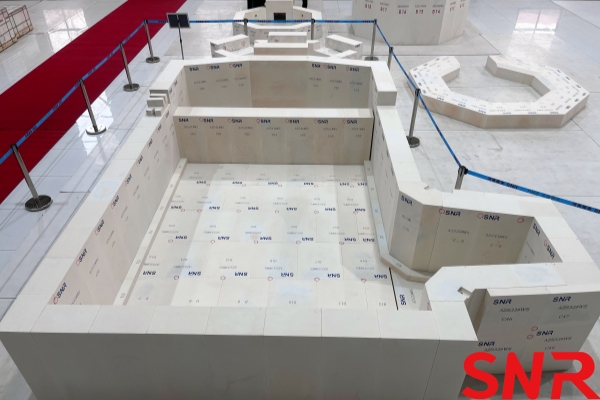
Henan SNR Refractory Co., Ltd. has been specializing in the production of fused cast AZS blocks for more than 25 years. We use high-quality raw materials and advanced fusion and casting technology and equipment to provide customers with high-quality products. From raw material procurement to finished product delivery, every step is strictly quality inspected to ensure that every indicator meets the standards, so you can use it with confidence.
 Should you have any inquiries or specific requirements, our team is ready to provide professional support and tailored solutions.

 info@snr-azs.com
 +86-18203976036