

The service life of a glass melting furnace directly determines the economic benefits and investment return period of a glass production line. As the core refractory material for the furnace, the service life of fused cast AZS (Alumina-Zirconia-Silica) blocks often becomes the "short board" limiting the overall operational cycle of the furnace. This paper systematically analyzes, from a microstructural perspective, three key factors affecting the life of AZS blocks – oxidation state (block color), shrinkage cavity filling rate, and glass phase stability – and explores the technical pathways to extend furnace life by 2-3 years through microstructure optimization. Research indicates that through precise oxidation control, optimized casting processes, and the application of recombination technology, the corrosion resistance and thermal shock stability of AZS blocks can be significantly improved, providing technical support for glass enterprises to achieve production goals of "longer furnace campaigns, high efficiency, and low cost."
1. Introduction: The Economic Significance of Furnace Life
2. Erosion Mechanisms and Life Bottlenecks of AZS Blocks
3. Three Major Technical Pathways for Microstructure Optimization
4. Quantitative Relationship Between Microstructure Optimization and Life Extension
5. Implementation Recommendations and Selection Guide
1. Introduction: The Economic Significance of Furnace Life
In the total cost structure of glass production, furnace construction and hot repair expenses account for a considerable proportion. For a medium-scale float glass furnace, the investment in refractories often exceeds half of the fixed asset investment. Fused cast AZS blocks, as the standard configuration for key areas such as sidewalls, throat blocks, and doghouses, directly determine the operational cycle of the entire furnace.
Currently, the designed service life of mainstream domestic fused cast AZS blocks is typically between 3-5 years. However, many furnaces show significant signs of erosion after about 3 years of operation – sidewall blocks thinning, glass phase exudation, and even the risk of glass leakage. This not only implies high hot repair costs (often tens of millions of yuan) but also entails production losses and product quality fluctuations.
So, is it possible to extend furnace life from 3 years to 5-6 years? The answer is yes. Research shows that through systematic microstructure optimization of AZS blocks, including precise control of the oxidation state, reduction of shrinkage cavities, and improved glass phase stability, furnace life can be extended by 2-3 years. This paper will analyze in detail, from a materials science perspective, how these microstructure optimization measures translate into macro-level service life extension.
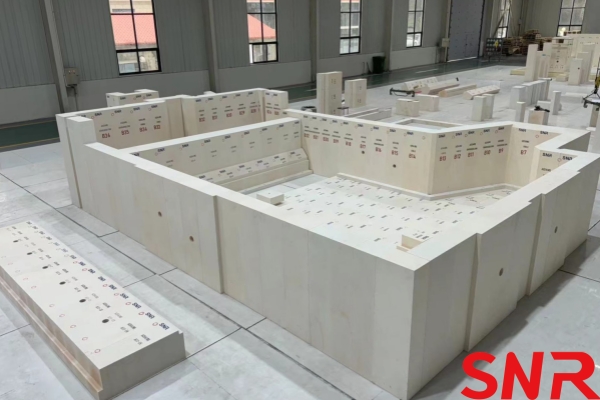
2. Erosion Mechanisms and Life Bottlenecks of AZS Blocks
2.1 Basic Structure of Fused Cast AZS Blocks
Fused cast AZS refractories are formed by melting a mixture of alumina (Al₂O₃), zirconia (ZrO₂), and silica (SiO₂) in an electric arc furnace at temperatures exceeding 2000°C and then casting. Their microstructure consists of three main crystalline phases:
Corundum (α-Al₂O₃): Provides mechanical strength and an erosion-resistant skeleton
Baddeleyite (ZrO₂): Enhances resistance to glass melt corrosion and utilizes its phase transformation characteristics to improve thermal shock resistance
Glass phase (silicate matrix): Binds the crystalline components but is also the weakest link in the material
AZS blocks are classified into three main grades (33#, 36#, and 41#) based on zirconia content. The higher the ZrO₂ content, the stronger the corrosion resistance, but the cost also increases, and the casting becomes more difficult.
2.2 The Three Stages of Erosion
The erosion process of sidewall blocks can typically be divided into three stages:
Stage 1 (0-1 year): The glass phase on the block surface softens at high temperatures and undergoes ion exchange reactions with the molten glass, forming a reaction layer.
Stage 2 (1-3 years): The reaction layer thickens, the glass phase inside the block begins to migrate toward the hot face, block porosity increases, and structural density decreases.
Stage 3 (beyond 3 years): The glass phase is largely lost, the crystalline skeleton is exposed and begins to dissolve, block strength drops sharply, and significant thinning due to erosion occurs.
It is the premature arrival of this third stage that forces many furnaces to face hot repair pressure after just 3-4 years. If the onset of this stage can be delayed, furnace life can be effectively extended.
2.3 Microstructural Roots of the Life Bottleneck
From a microstructural perspective, the three key bottlenecks limiting the life of AZS blocks are:
Uncontrolled Redox State: Reduced AZS blocks contain Fe²⁺, Fe⁰, and even residual carbon, which react with sulfates in the glass melt, generating persistent bubble defects and accelerating glass phase exudation.
Shrinkage Cavity and Porosity Defects: Shrinkage cavities and micropores formed during casting act as "high-speed highways" for glass melt penetration. Once the glass melt enters these defect areas, the erosion rate increases several-fold.
Insufficient Glass Phase Stability: The exudation temperature of the glass phase is too low. In the mid-to-late stages of furnace operation, it tends to separate out, leading to block loosening and strength loss.
3. Three Major Technical Pathways for Microstructure Optimization
3.1 Pathway 1: Oxidation Control – Transition from "Gray Blocks" to "Oxidized Blocks"
3.1.1 Correlation Between Color and Performance
The color of AZS blocks is a direct reflection of their oxidation state. Highly oxidized blocks appear light red or flesh-colored, with Fe³⁺ being the predominant form, while reduced blocks appear gray, with higher Fe²⁺ or Fe⁰ content.
Studies have found a strong correlation between block color and two key performance indicators:
Exudation Performance: The exudation amount of reduced blocks is 2-4 times that of oxidized blocks. This is because reduced materials contain more dissolved gases, which are released during heating, creating additional pressure that pushes the glass phase to exude.
Bubble Defects: When reduced blocks contact the glass melt, the following reaction is triggered:

The resulting SO₂ bubbles can be released continuously for several hours to days, seriously affecting glass quality.
3.1.2 Process Implementation of Oxidation Control
Achieving the desired oxidation state requires strict control of the furnace atmosphere during the melting stage. Specific measures include:
Using high-purity raw materials to reduce the introduction of impurities such as iron and titanium
Maintaining an oxidizing atmosphere during electric melting, avoiding excessive carbon-based reducing agents
Using spectrophotometry to test the color of each block, ensuring compliance with L-value (brightness) and C-value (chroma) standards
Research by SEFPRO has shown that AZS blocks meeting oxidation standards (high L-value, moderate C-value) perform significantly better in standard exudation tests compared to ordinary blocks.
3.2 Pathway 2: Shrinkage Cavity Control – From "Conventional Casting" to "Shrinkage-Free Casting"
3.2.1 Formation and Harm of Shrinkage Cavities
During the solidification process of fused cast AZS blocks, because the density of the liquid is higher than that of the solid, shrinkage cavities form inside the block. Depending on the casting process, the location and volume of shrinkage cavities vary:
PT (Rugular Cast): Shrinkage cavities are concentrated in the upper part of the block, suitable for non-critical areas.
WS (Shrinkage-Free): Shrinkage cavities are completely removed through a special casting process, resulting in a dense and uniform block.
ZWS (Zero Shrinkage): Intermediate between the two, with a small amount of residual micropores.
Shrinkage cavity areas are preferential pathways for glass melt penetration. Once the glass melt enters these areas, the erosion rate increases more than fourfold. For furnaces using electric boosting or producing ultra-clear glass, the bottom temperature is higher, and the risk of reaching the shrinkage cavity zone is greater.
3.2.2 Life Advantage of Shrinkage-Free Blocks
Radar wave non-destructive testing technology can be used to scan each block for internal defects. Comparative studies show:

In ultra-clear glass production or under intense electric boosting conditions, the erosion rate doubles for every 50°C increase in temperature. In these cases, using WS-grade shrinkage-free blocks is a necessary condition for ensuring furnace life.
3.3 Pathway 3: Glass Phase Stabilization – Breakthroughs in Recombination Technology
3.3.1 Principle of Recombined AZS Blocks
Traditional fused cast AZS blocks contain 15%-25% glass phase. This glass phase softens and exudes at high temperatures, becoming the starting point of block failure.
"Fused cast recombination" technology offers a completely new approach: crushing spent fused cast AZS blocks or frit into different particle size fractions, adding a small amount of binder, and then sintering at high temperature (1600-1700°C). During sintering, the glass phase exudes from the aggregate and reacts with the added active Al₂O₃ to form mullite, creating a robust ceramic bond.
3.3.2 Fundamental Microstructural Change
The microstructure of the sintered recombined block undergoes a fundamental transformation:
Glass phase largely consumed: The glass phase in the original block reacts with Al₂O₃ to form mullite, significantly reducing the glass phase content.
Formation of a protective shell layer: The glass phase exuding from the surface of coarse particles reacts with active Al₂O₃ to form a mullite shell, sealing the pathways for liquid phase exudation.
Improved high-temperature performance: The mullitized matrix significantly enhances creep resistance and thermal shock resistance.
3.3.3 Performance Comparison
Compared to ordinary fused cast blocks, recombined AZS blocks excel in the following aspects:
Higher exudation temperature: The onset temperature for glass phase exudation is significantly increased.
Reduced exudation amount: Due to the substantial consumption of the glass phase, the exudation amount is significantly lower.
Improved thermal shock resistance: The mullite matrix offers better thermal stress distribution capability.
Excellent creep resistance: Better dimensional stability at high temperatures.
This technical pathway is particularly suitable for production lines with high glass quality requirements and for enterprises looking to extend furnace life. At the same time, it enables the resource utilization of spent AZS blocks, aligning with the circular economy concept.
4. Quantitative Relationship Between Microstructure Optimization and Life Extension
4.1 Feasibility Analysis of Extending Life by 2-3 Years
Combining the three technical pathways described above, the contribution of each to furnace life can be estimated as follows:

Actual case studies confirm this analysis. A float glass production line using TY-AZS41 blocks (oxidation control + WS casting) for sidewalls extended its furnace life from the original 2-3 years to 5-6 years. Another coal-fired horse-shoe flame furnace achieved an operating cycle of nearly 7 years through zoned cooling maintenance and optimization of key areas.
4.2 Cost-Benefit Analysis
Take a 500-ton/day float furnace as an example:
Direct cost of one hot repair: approximately 20-30 million yuan
Production loss due to downtime (calculated over 30 days): approximately 15-20 million yuan
Total loss: 35-50 million yuan
If furnace life can be extended from 3 years to 6 years, this saves the cost of one hot repair over 6 years, averaging an annual saving of approximately 6-8 million yuan. The increased material cost of using high-performance AZS blocks (e.g., 41# WS grade) typically does not exceed 15%-20% of the total refractory investment, resulting in a very short payback period.
5. Implementation Recommendations and Selection Guide
5.1 Graded Selection Strategy by Furnace Zone

6. Conclusion
"Rejecting ‘short-lived furnaces‘" should not be just a slogan, but a technical decision for glass enterprises based on materials science. This study shows:
Oxidation state is the primary factor determining the life of AZS blocks. Upgrading from "gray blocks" to "oxidized blocks" can reduce the exudation amount by 2-4 times, significantly delaying the erosion process.
Shrinkage-free casting is necessary for severe operating conditions. In the context of widespread electric boosting and growing demand for ultra-clear glass, the use of WS-grade blocks is a prerequisite for ensuring safe furnace operation.
Recombination technology offers a new pathway for the circular economy. By consuming the glass phase and generating a mullite matrix, recombined AZS blocks achieve both performance improvement and resource conservation.
Systematic microstructure optimization can extend furnace life by 2-3 years. This extension not only brings direct economic benefits but also enhances the enterprise‘s return on assets and market competitiveness.
For glass manufacturing enterprises, "pinching pennies" on refractories should not focus solely on the purchase price, but rather on the total cost over the entire lifecycle. Choosing high-performance AZS blocks with optimized microstructure, although involving a higher initial investment, buys 2-3 years of additional operating time and saves tens of millions of yuan in hot repair costs – a calculation that every glass enterprise should carefully consider.
Henan SNR Refractory Co., Ltd. has been specializing in the production of fused cast AZS blocks for more than 25 years. We use high-quality raw materials and advanced fusion and casting technology and equipment to provide customers with high-quality products. From raw material procurement to finished product delivery, every step is strictly quality inspected to ensure that every indicator meets the standards, so you can use it with confidence.
Should you have any inquiries or specific requirements, our team is ready to provide professional support and tailored solutions.
 Contact Information:
Web: www.snr-azs.com
Email:wendy@snrefractory.com

 info@snr-azs.com
 +86-18203976036